

A job posting will happily spend 600 words on the role, the mission, and the fast-paced environment. Then it reaches the part about what you get, and offers one word: “benefits.”
This week we’ve measured pay disclosure, work-mode disclosure, what disclosed salaries say, and how long postings live. Today: what postings tell you about benefits. We ran the full text of 646,068 live job descriptions through a set of specific-benefit patterns, and the answer splits three ways.
How many postings name specific benefits?
- 56.3% name at least one specific benefit (health insurance, retirement, paid time off, parental leave, bonus, equity, or tuition assistance)
- 13.9% use the word “benefits” without naming a single one (“competitive benefits package”)
- 29.8% say nothing about benefits at all
A majority tells you something concrete. But 43.7% of postings, more than two in five, never name a single benefit: boilerplate or silence. And that’s not a part-time artifact: among postings explicitly marked full-time, 28.7% still say nothing, while part-time postings are actually less silent (23.2%), because hourly labor markets compete on benefits out loud.
Here’s what the postings that do get specific actually mention:
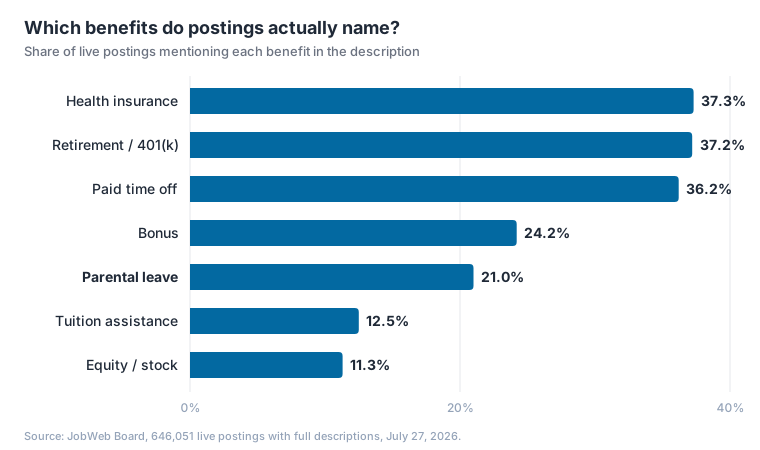
The big three (health, retirement, PTO) travel together around 37%, which makes sense: they come from the same HR template. After that it falls off fast.
The parental leave gap
Of the major benefits, the one most tied to actually planning your life shows up the least: parental leave appears in 1 in 5 postings. Health insurance is table stakes and gets named nearly twice as often. But whether a company offers twelve weeks or nothing is exactly the kind of information a huge share of candidates quietly need before investing in a process, and four out of five postings make you get to an offer conversation, or an awkward interview question, to find out.
Equity tells a similar story at 1 in 9, though the audience that needs it is narrower. If a posting does name equity, that’s usually a deliberate signal; absence is genuinely ambiguous.
Benefits silence travels with pay silence
Crossover with this week's pay data
This is now the third time this series has found the same pattern. Among private-sector postings that disclose pay, 79.3% also name specific benefits. Among those that don’t disclose pay: 41.7%. Postings that tell you one thing tend to tell you more, and the ones that omit pay are much more likely to omit other useful information too. My read: transparency isn’t a field on a form, it’s a policy, and you can read it from the outside.
Who names benefits, and who doesn’t
Split by industry, the pattern rearranges in ways the pay data didn’t predict:
| Industry | Names specific benefits | Mentions parental leave |
|---|---|---|
| Aerospace & Defense | 73.8% | 27.9% |
| Healthcare & Life Sciences | 71.2% | 23.8% |
| Retail & E-commerce | 65.4% | 35.8% |
| Software & Technology | 51.7% | 19.0% |
| Government & Public Sector | 51.8% | 10.9% |
| Higher Education | 44.3% | 1.1% |
| Industrial & Manufacturing | 38.2% | 13.6% |
| Professional Services | 20.8% | 4.3% |
But before reading that table as industry culture, one check first: several of these industries are dominated by a few enormous employers, and an “industry average” can just be their templates in a trench coat. The starkest case is retail. Its market-leading 35.8% parental-leave rate is really the work of its three biggest employers, who post two-thirds of the sector’s jobs; exclude them and retail’s rate collapses to 6.5%. The same concentration warning applies to professional services (nearly 90% of postings come from its top three firms) and staffing. Software and financial services, by contrast, are spread across hundreds of employers, so their numbers reflect genuine industry habits.
With that lens, three things hold up:
- A handful of giant staffing and consulting firms are the market’s most consistent withholders. They post enormous volumes, disclosed pay least in our earlier analysis, and name benefits in barely a fifth of postings. If your search runs through that part of the market, expect to learn everything at the phone screen.
- The biggest employers’ templates decide what the “market” looks like. Retail’s giants enumerate benefits in nearly every posting; most of the rest of the sector says little. Whether a posting informs you is set by one HR template decision at a handful of companies. More on the giants later this week.
- The institutional sectors go quiet for a different reason. Government, the most pay-transparent sector there is, names in-posting benefits barely half the time, and higher education mentions parental leave in 1.1% of postings. Public-sector benefits are standardized and documented elsewhere; the posting assumes you know. In-posting silence isn’t always a red flag; sometimes it points to a benefits system too big to paste into a job ad.
Three smaller checks, familiar from this series: postings with no stated work mode name benefits least (44.7%), postings that don’t state an employment type are the most silent about benefits (39.5%), and seniority barely matters (55% to 64% across every rank). The withholding cluster keeps showing up, and what a posting tells you is set by the employer’s habits, not the role’s.
What to do with this
- Read silence correctly. No specific benefits usually means “standard package, ask HR,” not “no benefits.” But vague-plus-no-pay is the withholding cluster this series keeps finding; weigh those postings accordingly.
- Ask for the benefits summary early. Every employer with a real package has a one-page benefits summary. “Could you send the benefits overview before our next conversation?” is a normal, reasonable ask after a first screen.
- Make the benefit you need a criterion. Fitcheck lets you set must-have and nice-to-have keyword criteria, so if parental leave or equity is non-negotiable for you, postings that name it rise and postings that don’t get flagged, as part of each Apply, Review, or Skip recommendation.
How we counted
Full-text analysis of 646,068 live postings with substantive descriptions (94% of the board), July 27, 2026. We match conservative, specific phrases per category: for example “401(k),” “parental leave,” “tuition reimbursement,” “stock options.” A posting counts as vague if it uses the word “benefits” without matching any specific category; incidental uses (“you’ll benefit from mentorship”) can land in that vague bucket, which is why we lean on the combined never-names-one figure rather than the vague/silent boundary. Industry figures are posting-weighted, so high-volume employers dominate them; we flag where that changes the story, and the retail and professional-services numbers should be read that way. Some of the pay-and-benefits correlation likely reflects that employers who write complete postings write complete postings; the practical read for a job seeker is the same either way. Mentioning a benefit is not a guarantee of its quality, and silence is not proof of absence; the numbers measure what employers choose to say. Pay disclosure means structured compensation data on the posting; sector comes from the hiring company’s profile; seniority and work mode are classified from the posting itself, as in the earlier posts in this series. Single-day snapshot; ratios have been stable.
Tomorrow: which job titles are growing right now. And later this week: the industries that hide pay the most, and why the biggest employers are the quietest.