

Somewhere today you read a job posting that described the role in 600 words. The mission. The values. The “fast-paced environment.” The five bullet points about what you’ll own in your first ninety days.
And not one number.
You are not imagining how common that is. We counted.
How many job postings list a salary?
JobWeb Board pulls live postings directly from employer applicant tracking systems and government job boards, so we can measure what employers actually publish, not what aggregators reformat. On July 23, 2026, the board carried 661,163 active postings from 3,293 employers.
Exactly 160,194 of them list compensation. That’s 24.2%.
Three out of four postings ask you to invest a tailored resume, a cover letter, and possibly weeks of interviews before revealing the single fact that determines whether any of it was worth your time.
The roles that need transparency most get the least
Here’s the part we didn’t expect. Break salary disclosure down by seniority and it runs backwards:
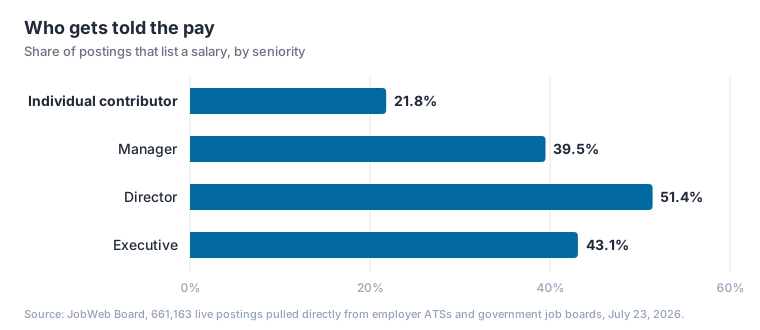
| Seniority | Active postings | % that list a salary |
|---|---|---|
| Individual contributor | 555,244 | 21.8% |
| Manager | 75,780 | 39.5% |
| Director | 18,211 | 51.4% |
| Executive | 11,938 | 43.1% |
A director posting is more than twice as likely to tell you the pay as an individual-contributor posting. The people with the least leverage, the least market information, and the most to lose from a lowball offer get the least transparency. The people who already have recruiters whispering ranges in their ear get the most.
The dip at the executive row is its own tell. Exec compensation is usually negotiated privately through retained search, so the posting never needs to show a number. That’s what having leverage looks like: the range follows you, not the listing.
Pay-transparency laws were written for the bottom of this table. The data says the top of the table is who’s actually being told.
One in six companies says nothing at all
Disclosure isn’t spread evenly across employers either. 18% of the 3,293 companies on the board list pay on zero of their postings. Not selective disclosure for sensitive roles. A blanket policy of silence, applied to every opening they have.
For context, among postings that do disclose, the median is $132,000 annual. What the disclosed quarter of the market looks like, and how it splits by work mode and job family, is its own story we’ll publish separately.
Isn’t disclosing pay required by law now?
In a growing list of places, yes. Colorado started in 2021, and thirteen states now require a salary range in the posting itself: California, Colorado, Hawaii, Illinois, Maine, Maryland, Massachusetts, Minnesota, New Jersey, New York, Vermont, Virginia, and Washington, plus Washington, D.C. and a handful of cities. Two of those are brand new as of this month: Virginia’s law took effect July 1, 2026, and Maine’s takes effect July 29, 2026.
Three things keep the overall numbers this low anyway:
- The laws are jurisdictional and full of thresholds. Coverage kicks in at 15 employees in one state, 4 in another. Some cover remote roles that could be worked from the state, some don’t. An employer with no covered presence can stay silent everywhere else.
- Enforcement is mostly complaint-driven. For many employers, the risk of a fine is cheaper than the leverage the number gives away.
- A compliance range is not a disclosure. “$50,000 to $250,000 depending on experience” satisfies plenty of statutes while telling you nothing. Our count treats any structured range as disclosure, so if anything, 24.2% overstates how much real salary information job seekers are getting.
Silence is a strategy
None of this is an accident. A company that withholds pay keeps its negotiating leverage, hides internal inequities, and loses nothing, because most of its competitors are silent too. Posting a range only carries a cost when candidates treat missing pay as a red flag.
So treat it as one. A posting that hides pay is telling you something about how that employer plans to negotiate with you.
What to do with this
You can’t fix disclosure rates. You can stop paying the cost of them:
- Filter on it. JobWeb Board lets you filter by salary, free, no account needed. Postings that disclose become your first pass.
- Make pay a criterion, not a hope. Fitcheck checks every job that reaches you (your forwarded alerts, the board, and a shared discovery pool) against criteria you set, including pay, and classifies each one as Apply, Review, or Skip with the reasons shown. A role that hides its number gets surfaced as exactly that, instead of costing you an evening.
- Spend your tailoring hours on the quarter of the market that respects them.
How we counted
Snapshot of live postings on JobWeb Board taken July 23, 2026. Postings are sourced directly from employer applicant tracking systems and government job boards, not scraped from aggregators. “Lists pay” means the posting carries structured compensation data; medians are annual figures. Seniority buckets are classified from job titles. This is a single-day cross-section of one large corpus, so the exact numbers drift daily, but the ratios have been stable across recent snapshots.
One more disclosure, since we’re asking employers for theirs: JobWeb is paid by job seekers, not by employers, so nothing in our incentives rewards keeping you scrolling past silent postings. That’s the whole philosophy.
Next in this series: Half of job postings won’t say where you’ll work.
Also coming: which industries are the best and worst about listing pay, and what happens to disclosure as employers get bigger. The short version: it’s not close, and it’s not who you’d guess.