

You found the perfect role. Then you saw it was posted 47 days ago, and a quieter question arrived: is anyone still reading applications, or are you about to write a cover letter to a filing cabinet?
This week we measured what postings hide and what they say when they talk. Today: how long they actually live.
The market moves daily
Start with the fact that frames everything else: over the past two weeks, roughly 14,000 new postings arrived and at least 7,000 closed every single day on our board. The market you searched yesterday is literally not the market you’re searching today.
That churn has two faces. Some postings vanish almost as fast as they appear. Others never seem to leave. Both change how you should search, so we measured both.
How fast do job postings close?
We took every posting born on our board over a one-month window, then watched what happened to each one for the next six to ten weeks:
| Time since posting | Still open |
|---|---|
| 7 days | 72.5% |
| 14 days | 55.8% |
| 30 days | 42.4% |
| Six weeks | 28.3% |
More than one in four postings is gone within a week. Nearly half are gone within two. If a role fits you, the difference between applying today and applying next Tuesday is real: for a quarter of the market, next Tuesday doesn’t exist.
The case against the Saturday ritual
The one-week rule depends on who’s hiring
The overall pace hides how differently parts of the market move. Same cohort, split by industry:
| Industry | Gone within 30 days |
|---|---|
| Human Capital & Recruiting | 94.9% |
| Government & Public Sector | 77.1% |
| Financial Services | 49.3% |
| Healthcare & Life Sciences | 41.7% |
| Software & Technology | 34.1% |
| Security, Risk & Compliance | 33.3% |
| Aerospace & Defense | 25.7% |
Each number is a hiring culture. Staffing and recruiting postings all but evaporate: agencies pull a req the moment it’s filled or lost, so what you see is nearly always fresh, and nearly always urgent. Government postings close on application deadlines, not vibes: three out of four are gone within a month, and when the date passes, no amount of enthusiasm reopens the form. At the other end, defense, security, and software postings routinely outlive a month, because clearance checks and long interview pipelines slow everything down.
So calibrate your urgency to the market you’re in. In government and staffing, a posting you like is a this-week task. In defense or tech, the posting will probably still be there next month, but pair that patience with the age question below.
We also checked whether seniority changes the pace. It barely does: individual contributor, manager, and director postings all close within a couple points of each other. Speed is set by the employer’s process, not the role’s rank.
How old are the postings you’re browsing?
The other half of the story is the postings that don’t close. Most of the board’s 677,096 live postings carry the employer’s own posted date, and for this analysis we held ourselves to the strictest cut: postings that carry that date and that we re-confirmed as open within the past week. Nothing below is a dead posting we failed to notice or an age we guessed:
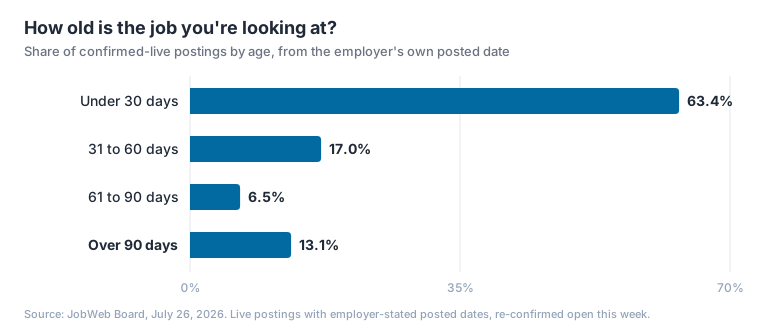
The median confirmed-live posting is 19 days old. More than a third of the jobs you’re browsing right now are over a month old, and one in eight has been sitting for more than 90 days. That last group isn’t a stale-data illusion: these are postings employers are actively keeping up.
Is a 90-day posting a ghost job? Not automatically. Some roles genuinely take a quarter to fill, and some companies run evergreen postings for positions they hire continuously. But a posting that’s been open three months is asking you to believe one of three things: the bar is very high, the pipeline is very slow, or nobody is actually hiring against it. Two of those three mean your application isn’t going anywhere fast.
Age is information. A fresh posting means an active decision to hire. A stale one means a question you should ask in the first screen: “How long has this role been open, and what’s the timeline?”
Why this shapes how JobWeb works
This churn is why JobWeb Board pulls postings directly from employer systems and removes them when they disappear at the source, and why Fitcheck exists at all: a market that turns over daily needs something watching it daily. Fitcheck checks your forwarded alerts, the board, and a shared discovery pool continuously and classifies every new role as Apply, Review, or Skip with the reasons shown, so the one-week postings don’t slip past you.
What to do with this
- Apply early. A quarter of postings close within seven days. When something fits, treat it as this week’s task, not this month’s.
- Ask about age. For anything over 60 days, ask in the first conversation, in so many words: “I noticed this role has been open since the spring. Is the team still actively interviewing, and what does the timeline look like from here?” A crisp answer (“we’re in final rounds, deciding by mid-August”) means you’re in a pipeline. A vague one (“we’re always evaluating great candidates”) means you’re in a parking lot.
- Stop searching on a weekly clock. Either check daily, or have something check daily for you.
How we counted
This covers every kind of role on the board: salaried and hourly, every seniority, worldwide. Closure speed comes from a one-month cohort of newly created postings, followed for six to ten weeks; we exclude each company’s initial import (whose creation dates reflect when we first indexed the company, not when the employer posted) and sources where closure detection lags. Industry splits use the hiring company’s primary industry, and seniority is classified from job titles. Posting ages use the employer’s own stated posted date, and only postings re-confirmed as open within the past seven days are counted; anything not recently re-verified is excluded rather than assumed alive, and postings without an employer date are excluded rather than guessed. Daily churn is the two-week average across the board; the closure figure is a floor, since a closure only counts once we observe it at the source. “Closed” includes filled, cancelled, and expired without distinction.
Tomorrow: what job postings say about benefits, which is mostly nothing. And later in the series: the industries that hide pay the most, and why the biggest employers are the quietest.