

You read the whole posting. The responsibilities, the values, the “collaborative environment.” You get to the end and still can’t answer the only logistical question that matters: can you do this job from where you live, or will you be in an office three days a week?
Yesterday we showed that three out of four job postings won’t tell you the pay. Today, the other thing they won’t tell you.
How many job postings say whether a job is remote?
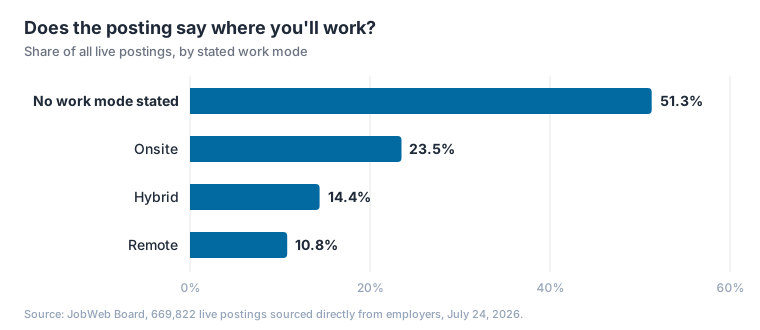
On July 24, 2026, JobWeb Board carried 669,822 live postings, pulled directly from employer applicant tracking systems and government job boards. Of those, 343,310 never state a work mode at all. That’s 51.3%.
More than half the market expects you to guess.
| Stated work mode | Active postings | % of all postings |
|---|---|---|
| No work mode stated | 343,310 | 51.3% |
| Onsite | 157,642 | 23.5% |
| Hybrid | 96,589 | 14.4% |
| Remote | 72,281 | 10.8% |
Among the postings that do say, about half are onsite, and roughly one in five is remote. But that’s one in five of the postings that answer the question. Fully remote isn’t one in five postings. Counting the silent half, it’s one in nine.
42% won’t tell you the pay or the work mode
Cross today’s numbers with yesterday’s and the combined picture is worse than either alone: 283,347 postings (42.3%) state neither the pay nor the work mode. And just 16.1% state both, which deserves saying plainly: only one posting in six tells you both what it pays and where you’ll work. The other five are missing at least one of the two facts you’d want before spending an evening on an application.
Crossover with yesterday's pay data
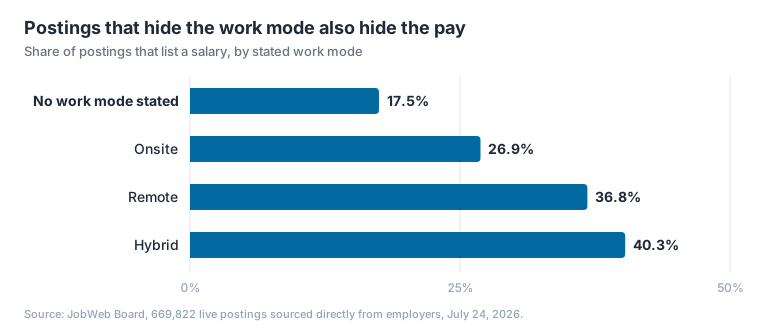
Yesterday we measured how often postings list a salary: 24.2% overall. Cross that with today’s work-mode groups and the pattern is hard to miss:
| Stated work mode | % that list a salary |
|---|---|
| No work mode stated | 17.5% |
| Onsite | 26.9% |
| Remote | 36.8% |
| Hybrid | 40.3% |
Opacity clusters. A posting that won’t tell you where you’ll work is also the least likely to tell you what it pays, at less than half the rate of hybrid postings. Postings that disclose one thing tend to disclose the other, and the ones that withhold tend to withhold across the board.
Which means vagueness is not noise. It’s a signal about how an employer shares information with the people it wants to hire.
Isn’t “not stated” just a parsing gap?
Fair question, since these numbers come from software reading posting text. Our classifier looks for the work mode anywhere in the posting: the location field, the title, the body, the boilerplate. If it marks a posting unknown, the words genuinely are not there.
Could a human occasionally infer what the software can’t? Sure, sometimes an office address hints at it. But that’s the point: if a system that reads every word can’t find the answer, a job seeker skimming their fourteenth posting at 11pm won’t either. The information is absent, and absence is the employer’s choice.
What to do with this
The half of the market that states its terms is the half that respects your time. Act accordingly:
- Filter on it. JobWeb Board filters by remote, hybrid, and onsite, free, no account needed.
- Make work mode a criterion, not a guess. Fitcheck checks every job that reaches you (your forwarded alerts, the board, and a shared discovery pool) against the work modes you’ll actually accept, and classifies each one as Apply, Review, or Skip with the reasons shown. Postings that hide their work mode get flagged as exactly that.
- Stop paying the phone-screen tax. Finding out “actually it’s four days in Midtown” twenty minutes into a call is the cost of a posting that didn’t say. You can decline to pay it.
How we counted
Snapshot of live postings on JobWeb Board taken July 24, 2026. Postings are sourced directly from employer applicant tracking systems and government job boards, not scraped from aggregators. Work mode is classified from the posting’s own structured fields and text; “no work mode stated” means the posting said neither remote, hybrid, nor onsite anywhere. Salary figures use the same definition as yesterday’s pay-transparency post: structured compensation data present on the posting. Single-day cross-section; exact numbers drift daily, but the ratios have been stable across recent snapshots.
Tomorrow: what the quarter of the market that does disclose pay reveals about salaries right now. And later in the series: the industries that hide the most, and why the biggest employers are the quietest.